The spreadsheet beside the software
The most reliable sign of all. That spreadsheet exists because the software can't do something you need every day.
Every business is unique. Your software should be too.
Businesses shouldn't adapt to software. Software should adapt to businesses.
1 Diagnostic · free2 Blueprint · $1,2503 Build · from $9,500
No signup to explore · The free diagnostic takes two minutes
Open a record, move it forward, switch on an automation — this is a real system, not a picture.
Not sure yet what you need?
Start with the diagnostic: nine questions, two minutes, free. The Blueprint comes after, when you want the priced scope of your project.
Off-the-shelf software is built for the average of ten thousand businesses. So it has to speak a language nobody actually speaks. In it, a garage calls a repair “an opportunity”, a lift “a resource”, a customer of twelve years “a contact”. That sounds harmless. It isn't: every gap in vocabulary is a decision the software can no longer make for you, and that someone will have to make in its place, every single day.
The most reliable sign of all. That spreadsheet exists because the software can't do something you need every day.
“Notes” holds the plate number, “Tag 2” marks the urgent jobs. The software never planned for your trade, so you bent it.
The same information typed twice, into two tools that don't talk. That isn't diligence, it's a daily tax.
Custom software costs more to build than a monthly subscription. It would be dishonest to pretend otherwise. The real question isn't what the software costs: it's what the one you already use is costing you.
In that case, an off-the-shelf subscription is the right purchase. We'll tell you so.
The tipping point is when the gap costs you more than the system does.
The calculator has you enter your own volumes and your own recovery assumptions. It shows the arithmetic line by line, and gives you the monthly figure above which a system stops paying for itself. No email required to see the result.
The question is never “what tool do you have?”. It's “where does information change hands, and what does it lose on the way?”. That's almost always where the money is.
How can a request reach you? Phone, form, email, direct message, someone walking through the door. We count them all — including the ones nobody watches.
Every point where information passes from one person to another, or one tool to another. A handoff with no trace is a leak waiting to happen.
What a human settles twenty times a week by the same rule. A rule that's stable and written down is a rule a system can hold for you.
The words your team really uses. Those are the ones that will appear in the software — not a vendor's, who has never set foot in a shop.
We don't start from a blank page for every client: that would bill you for learning things already solved. The foundation — intake queue, pipeline, follow-ups, dashboard, audit log — exists and runs. What changes from one business to the next is the configuration. And it isn't cosmetic.
How a file travels through your shop. A garage follows a vehicle from the counter to the lift; a firm follows a matter from consultation to billing. Those aren't the same columns.
Work order, lift, plate. Or matter, limitation date, fees. The interface speaks your language, not a vendor's.
What should go out on its own, and when. A missed call recovered within the minute has nothing to do with a matter follow-up on day 30.
What you actually watch. Bays in use and outstanding estimates on one side; deadlines and billable hours on the other.
That's what makes custom software affordable: you pay for the adaptation, not the rebuild.
H&S can't show you a client case study: we don't have a client on these products yet, and we'd rather say so than invent a reference. Here is what does exist, runs, and can be checked.
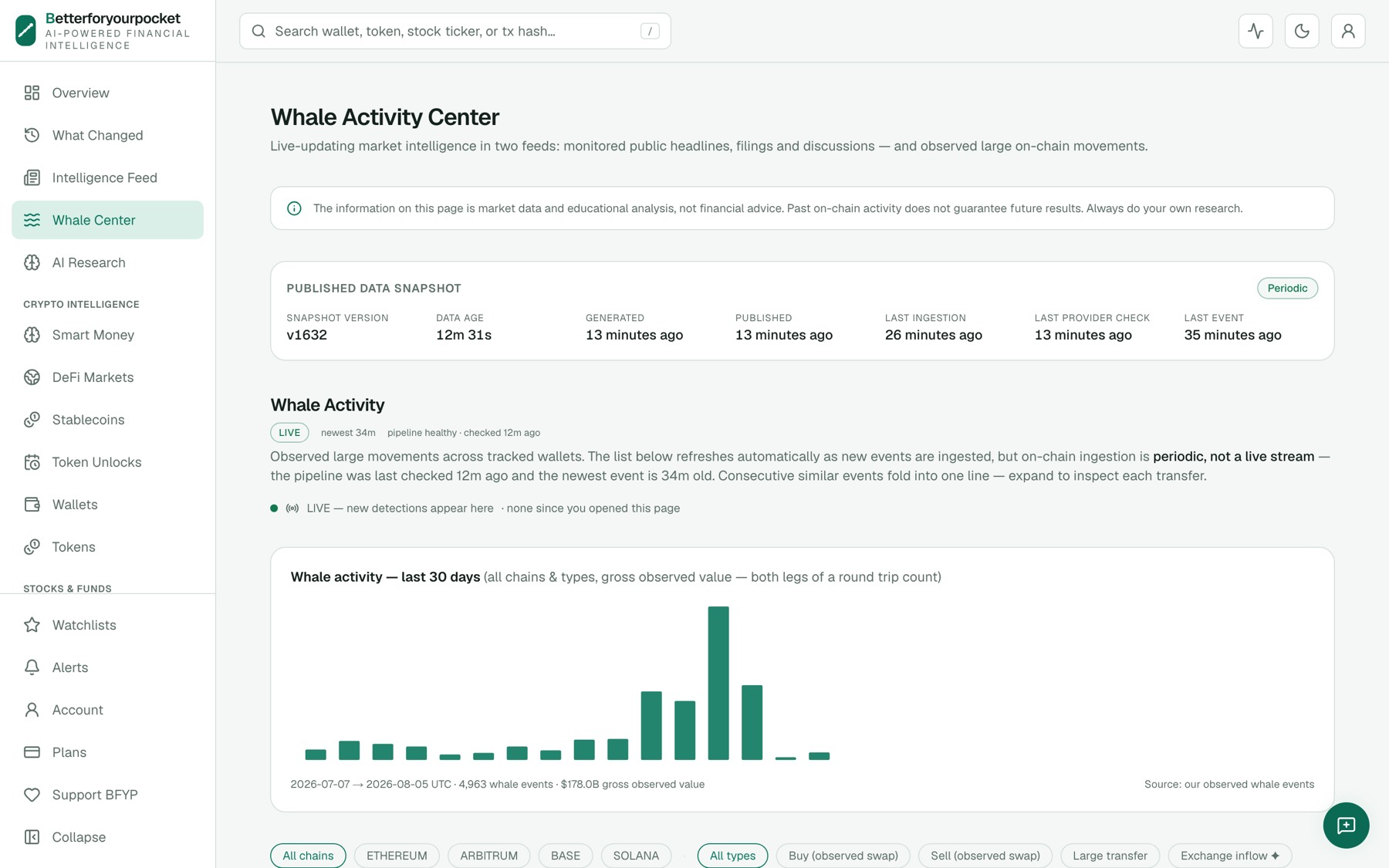
Captured on betterforyourpocket.com. The data shown are public on-chain movements — no user data appears. The snapshot states its version, its age and the last ingestion time: what the platform knows, and since when.
See it liveVideo or on site. We listen to how you work. Nothing to prepare, and nobody will ask you for a budget at this stage.
What we saw, where the risky handoffs are, what automates first in your case. You keep it even if you never work with us, and even if our conclusion is that you don't need us.
What's included, what isn't, the price, the date. In writing. If there's no follow-up, it stops here without pestering.
We build, wire, test; you sign off. Two rounds of revisions are included in the contract.
No technical skill required. Hosting, maintenance and support follow. The system runs, you watch the dashboard.
These aren't promises of results — we guarantee no revenue figure, and be wary of anyone who does. They're commitments about how we work: enforceable, and written down.
The price and what it covers are written before we start. No hourly billing that drifts, no surprise overrun.
The timeline for the first system is set after the assessment: it depends on the scope retained, the integrations, the data already available and the sign-offs we need from you. It is written into the contract before any commitment — and the clock only runs from the moment we have the access and sign-offs listed in the contract, each with the date we need it by.
Planned from the start. An adjustment after delivery isn't an extra, it's a normal step.
The system and the data are yours, exportable at any time, in an open format. Leaving should never be expensive.
We don't use the difficulty of leaving as a retention argument. If the system stops serving you, it should be able to follow you elsewhere.
If off-the-shelf software fits your need better, we'll tell you — and we'll tell you which one. A engagement that doesn't serve you doesn't serve us either.
We start with your answers, not with a call: a few minutes to describe how work comes in, and you leave with a written recommendation. The fifteen-minute call comes next, once it has something to stand on — and if it turns out you don't need us, we'll tell you that too.
Reply within one business day. No pestering.